
Do People Living with Dementia Deserve to Live a Good Life?

When we give this some thought, our immediate response is: "Of course, every human being deserves a good life!" But what exactly does a good life entail, and is it achievable for those living with dementia?
Traditionally, psychologists and philosophers have agreed that a "good life" comprises two main elements: happiness and meaning. Happiness can be understood as the absence of fear and pain, coupled with a sense of inner well-being. Meaning, on the other hand, involves living with purpose, being intentional, and contributing to society. Recent research has now introduced a third element, known as psychological richness (1). This isn't necessarily about pleasant or practical experiences, but about those that add value to our daily lives and make them more exciting.

Returning to our initial question of whether individuals with dementia can experience a good life, I believe this is indeed possible. By examining the components of a good life, the crucial factor is that those on their dementia journey require support to achieve it. We can alleviate unnecessary pain and fear by creating safe and familiar environments that foster happiness. As a community, we can encourage them to utilise their skills and engage in activities that they find enjoyable and meaningful. Additionally, we can help them experience psychological richness by not eliminating all of life's challenges. In contrast, guiding them through these challenges allows them to feel a sense of accomplishment and worth.

But what does this approach look like in real life? This month, we had to say goodbye to Debbie, one of our visitors who has loved coming to Home4All. Over the last four years, her dementia progressed to an advanced stage and, unfortunately, Home4All is no longer the right place for her. But, how do you say to someone who loves coming here that she can’t come anymore? She would have been in tears, and it would have violated all three components of her living a good life. At the same time, it was important for our other visitors to recognise that she had been part of Home4All for the last four years and that this was her final day. So, instead of a farewell, we decided to hold a celebration for her and told her what a great woman she is. We did this by making a special card with photos, signatures, flowers and a beautiful cake. She was stoked! She realised it was all about her and she felt special and loved. Due to her memory loss, by next week, she may not remember that she used to go to Home4All. However, looking at the card at home will still give her a good feeling.

In supporting people with dementia, focusing on the three components can serve as a valuable guide to help them experience a good life as frequently as possible. At Home4All, we intentionally design activities that foster meaning, create happiness, and offer enriching experiences, enhancing the lives of our visitors at every stage of their dementia journey.
To illustrate how this can be achieved, we include the testimony of Rachel Morris about her sister Debbie to illustrate that people living with dementia can experience happiness, live a life with meaning and richness.
Debbie’s Story
By Rachel Morris
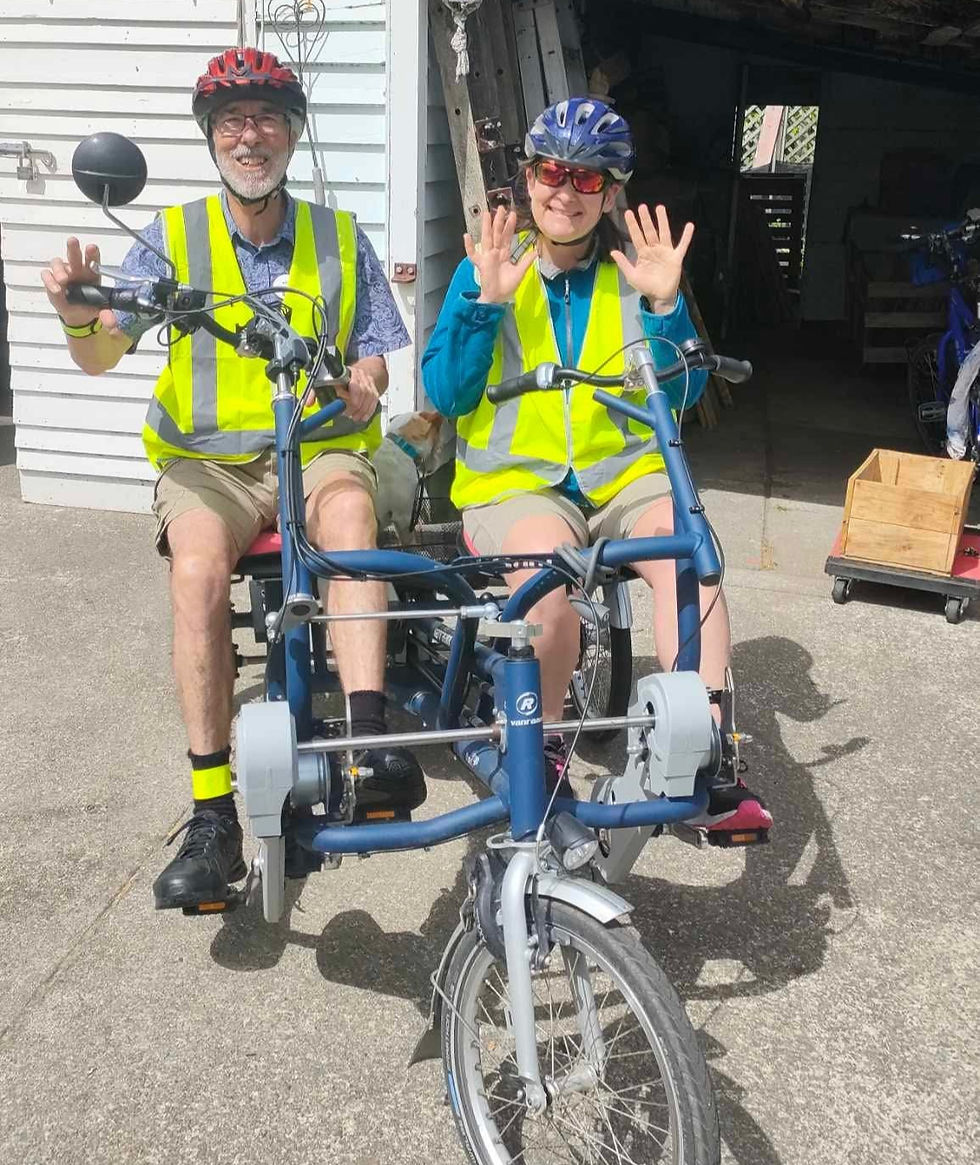
I guess we missed the first few signs. We were busy navigating our mother's journey with Alzheimer's and never expected one of us would get it...and certainly not so young! She had held her position at work for over 20 years when more and more mistakes were noticed. After losing her job, repeatedly losing her keys, phone or wallet, forgetting days and appointments, anniversaries, birthdays, etc, etc. The signs were all too similar. It took 6 long years of being bounced around by different specialists and medicated with different medications that did nothing, until finally an official diagnosis of Alzheimer's was given when she was only 47 years old. Fit, healthy and in the prime of her life!

It got to a stage where we were uncomfortable leaving her on her own for long periods whilst at work ourselves, and it seemed all available dementia respite care was set up for the elderly; nothing suited a very active woman. The next challenge was then finding the correct support for her. Those were very hard years, and her world began to slowly shrink. Unable to obtain work or even drive to a friend's place, isolation was setting in, she felt like a burden, and she was depressed.
The timing couldn’t have been better when we found Home4All late 2021, we started slowly and we never looked back! It was a beautiful thing to see as she slowly opened up again, her smile, her cheeky and her confidence. This was more than being “looked after”, it was friendship and laughter, a place within a community sharing, creating, finding purpose. An environment that families are welcomed to share in and we have taken every advantage of that.

All of this has been incredibly important in her journey with Alzheimer's, not just for her but her carers as well and we feel it has helped us keep her out of more permanent care for longer... but this disease is cruel and her progression was always going to happen. Five years later and Home4All is still a community that we all love being a part of, we’ve met some truly wonderful people and we couldn’t thank them all enough for absolutely every “happy day” that they have given our sister.
We highly recommend Home4All!!! We have seen the difference this type of care has made, not just in our sister but many others that we have met along the way.
Oishi, S., & Westgate, E. C. (2021, August 12). A Psychologically Rich Life: Beyond Happiness and Meaning. Psychological Review. Advance online publication. http://dx.doi.org/10.1037/rev0000317


Comments